Scout & the Gumboot Kids

scoutandthegumbootkids_poster_1

Scout the mouse sends the Gumboot kids through a series of scavenger hunts to identify clues in nature. The children become mindful of their environment as they search for the clues.  The show encourages children to get outside!! And to explore nature, to be mindful of their environment, and to slow down and notice the sights, sounds and textures in nature.  Each episode introduces a mindful pause with a guided mindful exercise, whether it is to observe, listen, taste, feel, and touch or to be mindful of their friends; the children learn to take a moment to truly become aware of their surroundings.

Created by Eric Hogan and Tara Hungerford, Scout & the Gumboot Kids is a refreshing change in children’s programming. Each episode is a short 5 minutes of lovely mindfulness.

Full episodes are below:

Pause for a moment and check it out!

Lori

The Art of Breathing

The Art of Breathing.png

The average person takes about 15 breaths a minute. Breathing is something we do with little thought. However, when we are feeling angry, anxious or frightened our breathing quickens and oxygen moves from our brains and is sent to our limbs in a Fight, Flee or Freeze response.  The part of our brain responsible for this is called the amygdala and its primary purpose is to keep us safe, but it can sometimes think we are in danger when we really aren’t.  When we are in a Fight, Flee or Freeze response and less oxygen is reaching our brains, we often fail to think clearly.  This is when we have to get more oxygen back to our brains and we can do this by paying attention to our breathing.

I remember being told to breathe when I became anxious prior to exams; but breathing in and out often left me feeling more anxious and often in a state of panic. The advice to breathe slowly was sound but what I failed to know was that there was an art to slowing my breath.

Square breathing was introduced to me by an elementary school teacher and it has become so beneficial to not only me but also my children when trying to calm ourselves. The best part of square breathing is that it is really very simple to perform.

With your finger, trace a square in the air. Each line of the square should take four slow counts.

  • Now breathe in for the first line of the square, as you are breathing slowly count …1,2,3,4
  • Hold your breath for four counts as you trace the second line … 1,2,3,4
  • Exhale for four counts while still tracing the square … 1,2,3,4
  • And hold for four counts as you trace the last line … 1,2,3,4

Continue inhaling, holding, exhaling and holding for 2 minutes. Check in with yourself, how are you feeling? Like anything new, learning ‘calming breath’ takes practice.  Be patient with the process and with yourself. Practice throughout your day and as you improve you will likely be able to increase the hold count for a longer stretch.

Thank you, Lori

Don’t forget to breathe!

Our lives have become so busy;  Busy running the kids to and from activities, busy with errands, busy with work and busy with so many other items on the ‘to-do’ list. This busyness has become a badge of honor for us.  Ask anyone how they are and the answer is generally ‘I am just so busy’ followed by a list of all the committees and projects and kids activities they are involved in.  Busyness in North America has become the cultural norm, but why is that? Are we trying to keep up in order to feel valued and worthy?  Are we afraid to say ‘no’ for fear of disapproval?

It can be a stressful world and when we continue to put ‘others’ needs ahead of our own we become greatly unbalanced. I would suggest that learning to say ‘no’ is an important step in reclaiming our lives but this takes practice and some soul-searching.  Moving from a life that is not dependent on people pleasing and the approval of our peers, towards a life free of un-fulfilling commitments takes time, but reclaiming a balanced life is definitely worth it.

Every decision and goal we make starts with one small action and for today that small action is to do something for ‘you’. It is a small request and the exercise is very simple.  Breathe!

Today I’d like you to close your eyes for 2 minutes, place your hands on your upper abdomen and breathe. Breathe into your abdomen filling it up and releasing the breath.  Notice the motion of your hands as your abdomen expands and relaxes.  If your mind wanders, acknowledge the thought and let it go.  Bring your attention back to your hands, expanding and releasing.

Try this practice throughout the day, be patient and gentle with yourself, change takes time.

For help with the breathing exercise follow with the link below.

http://doasone.com/BreathingRooms.aspx?RoomID=2

What is Mindfulness

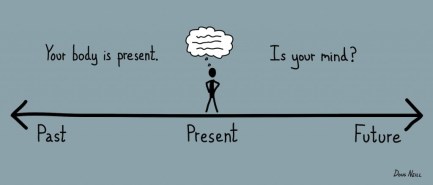
What is Mindfulness?  Mindfulness can be a confusing concept and is widely associated with meditation.  Although meditations can be used  to support the mindfulness practice the actual art of mindfulness is in the idea of intentionally paying attention in the present moment.  The pioneer of mindfulness Dr. Jon Kabat-Zinn defined mindfulness as “The awareness that emerges through paying attention on purpose, in the present moment, and non-judgmentally to the unfolding of experience  moment by moment.”

Consider sensations in the body, those associated with touch, sound, taste, sights, smell and also thoughts and emotional experiences.  Now consider purposefully bringing awareness to those sensations, this is mindfulness.

Try a short exercise, close your eyes for 30 seconds and listen very carefully to the sounds around you, if your mind wanders to your to-do list, gently acknowledge your thought and return to listening to the sounds around you.  Congratulations, you have just experienced mindfulness in practice.

Through the practice of mindfulness we learn that by intentionally being attentive to experiences in an open and honest manner without any measure of controlling the outcome we begin to understand a way of living that can bring greater joy and happiness.

Mindfulness, as with anything you want to become proficient at, takes practice.  So for today, find a place in your home and sit quietly for several minutes.  Now listen for sounds, pay close attention to sounds you don’t normally notice and those that are familiar.  Once finished make a list of the sounds you heard while mindfully listening.

Mindfulness

mindfulness-1024x438

Namaste, welcome to my page on mindfulness. I was introduced to the concept of mindfulness a few years ago while guiding my children through the anxieties of school. Mindfulness guides you to be aware in the present moment and benefits people of all ages. Join me on a journey through the art of mindfulness.

Thanks for visiting, Lori